

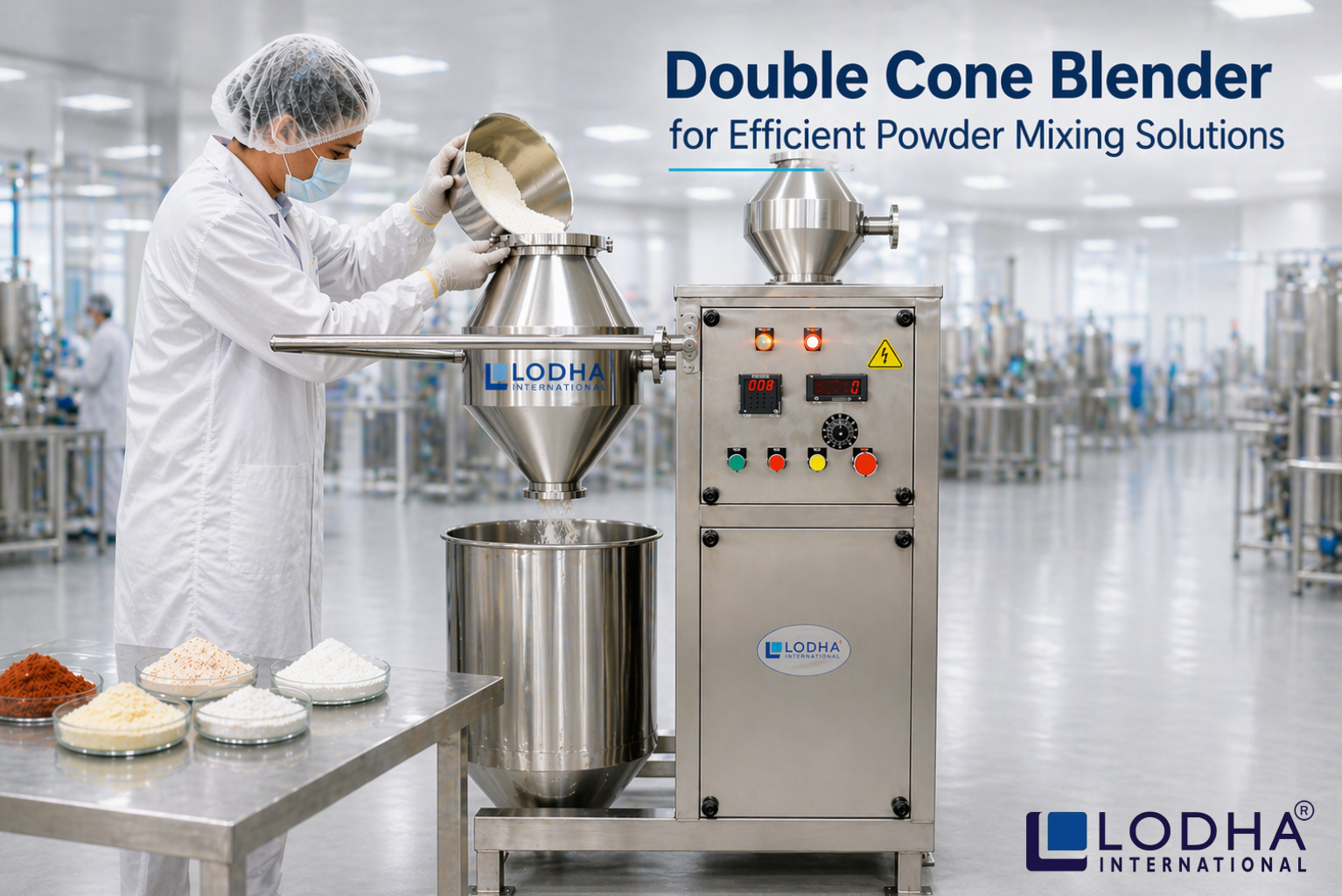
Key Takeaways
- Double Cone Blenders provide uniform mixing without damaging materials
- Ideal fill level is critical for achieving consistent results
- Suitable for pharmaceuticals, chemicals, food, and lab applications
- Automation features improve efficiency and reduce manual handling
- Choosing the right manufacturer impacts long-term performance
In industries where powder mixing plays a critical role—pharmaceuticals, chemicals, food processing—the margin for inconsistency is surprisingly small. Even slight variation in blending can affect product performance, stability, or compliance. That’s where the right equipment quietly becomes the backbone of operations.
A Double Cone Blender manufacturer in India doesn’t just supply a machine; it influences how efficiently materials combine, how consistently batches perform, and how smoothly production scales. The double cone design, in particular, has remained relevant for a reason—it handles delicate powders and granules without aggressive force, yet still delivers uniform results.
This blog breaks down how a Double Cone Blender works, where it fits best, and what actually matters when selecting one for your operations.
What is a Double Cone Blender?
A Double Cone Blender is a rotating mixing machine designed for homogeneous blending of dry powders and granules. Its structure—two cones joined at the base—creates a natural tumbling motion.
Instead of relying on blades or high-speed agitation, it uses:
- Folding
- Spreading
- Cascading
This combination allows materials to mix evenly without damaging particle integrity.
In lab environments, the smaller variant—often referred to as a Lab Double Cone Blender—is used for R&D and formulation trials. These compact versions are especially useful when testing batch behaviour before scaling to production volumes.
How Does a Double Cone Blender Work?
At its core, the mechanism is simple—but that simplicity is what makes it effective.
- The blender rotates on its axis
- Materials move from one cone to the other
- Gravity causes continuous redistribution
- Repeated movement creates intermeshing of particles
The result is a uniform blend without excessive shear.
A key detail many overlooks is the fill level. For optimal performance, the effective volume typically sits between 35% to 70% of the total capacity. Overfilling reduces movement, while underfilling limits interaction.
Where is a Double Cone Blender Used?
This isn’t a niche machine. Its applications stretch across multiple industries:
- Pharmaceuticals (API blending, excipients)
- Chemicals (fine powders, granules)
- Food industry (spices, dry mixes)
- Cosmetics (powder formulations)
In laboratories, the Lab Double Cone Blender supports research and development, helping teams validate formulations before moving into production.
In production environments, capacities can go up to 3500 litres, depending on process requirements.
Key Features That Actually Matter
Not all blenders are built the same. The real value lies in how the machine integrates into your workflow.
Here are some features that make a noticeable difference:
- PLC-controlled automated loading and discharge
- Butterfly valve design for easy cleaning
- Stainless steel contact parts for hygiene and durability
- AC variable frequency drive for speed control
- Shaft-mounted gear motor reducing maintenance concerns
- Safety interlocks for operator protection
These aren’t just technical additions—they directly impact downtime, cleaning cycles, and operational consistency.
Advanced Design Options for Better Results
Standard blending works well, but some applications demand more precision.
Customisation options include:
- Internal deflector cones for improved mixing uniformity
- Angled shell designs for complex materials
- Automated drum loading systems for dust-free handling
The automated drum system, in particular, changes how material handling works. Instead of manual loading (which risks spillage and contamination), the system allows sealed transfer from drums into the blender and back.
That’s not just about convenience—it’s about process control.
What to Look for When Choosing a Double Cone Blender manufacturer in India
Here’s where most buyers go wrong—they focus only on price or capacity.
A more practical approach would be:
1. Customisation Capability
Standard machines rarely fit every process. You need flexibility in design.
2. Material Quality
Stainless steel construction isn’t optional, especially for regulated industries.
3. Automation Integration
If your process is evolving, your equipment should support PLC-based control.
4. Maintenance Practicality
Quick-release components and simplified mechanisms save time during cleaning and servicing.
5. Real Application Understanding
A manufacturer who understands your industry will recommend better configurations—not just sell a machine.
Choosing blindly here often leads to inefficiencies later.
Why Double Cone Blenders Still Make Sense Today
With so many modern mixing technologies available, it’s fair to question whether this design is still relevant.
The answer is—yes, and for specific reasons:
- Gentle mixing avoids particle degradation
- Energy consumption remains relatively low
- Cleaning is simpler compared to complex mixers
- Ideal for batch processing
In industries where consistency matters more than speed, this design still holds strong.
Why Choose Lodha International LLP
When working with Lodha International LLP, you’re not just selecting equipment—you’re working with a team that understands how blending fits into your larger process. We focus on practical machine design, not overcomplicated systems that look impressive but add little value. Our Double Cone Blenders are built with attention to usability—easy cleaning, controlled operation, and adaptability to different batch requirements. Whether it’s a lab-scale unit or a large production model, we approach each requirement with a problem-solving mindset. That means fewer adjustments later, smoother integration, and equipment that actually supports your workflow rather than disrupting it.
Conclusion
A Double Cone Blender might look simple at first glance, but its impact on production consistency is anything but minor. From laboratory trials to full-scale manufacturing, it offers a reliable way to achieve uniform blending without damaging sensitive materials. The real difference, however, comes down to how well the machine fits your process. Capacity, automation, cleaning, and design flexibility all play a role in long-term performance. Choosing the right Double Cone Blender manufacturer in India is less about comparing specifications and more about understanding how the equipment will behave in your actual working environment. When the fit is right, the benefits show up quietly—in smoother operations, consistent batches, and fewer interruptions. And in most industries, that kind of reliability is what really counts.
Looking for the right blending solution? Call +919687731331 or email info@lodhapharma.com to discuss your requirements with our team today.