

Key Takeaways
- Selecting a capping machine starts with understanding the container and closure type needs.
- Consider production speed alongside bottle dimensions for optimal machine selection.
- Lodha International LLP offers diverse capping configurations for different pharmaceutical packaging applications.
- A proper cap sealing machine must integrate seamlessly with upstream and downstream equipment.
- Investing in high-speed machinery is only beneficial if the entire line supports compatible throughput.
Lodha International LLP is a leading manufacturer of cap sealing machines for pharmaceutical and packaging applications.
High-speed pharmaceutical packaging requires more than simply placing a cap on a bottle or vial. The closure type, container dimensions, required output and integration with upstream and downstream machines all influence machine selection.
As a Cap Sealing Machine Manufacturer in India, we offer different capping configurations so buyers can select a system that matches their actual packaging process rather than choosing equipment by speed alone.
Start With the Container and Closure Type
The first decision should be based on the container and cap combination.
Pharmaceutical packaging may use plastic screw caps, CRC caps, ROPP closures or vial caps. Each closure requires a different handling and sealing arrangement, which is why one capping mechanism should not automatically be selected for every application.
Our capping range includes single-head, multi-head, linear and high-speed configurations for bottle and vial applications.
Which Cap Sealing System Fits Your Line?
Different configurations serve different production requirements. The main options can be compared as follows:
| Capping Configuration | Typical Application | Selection Focus |
|---|---|---|
| Screw Capping Machine | Plastic screw or CRC caps | Bottle and cap compatibility |
| ROPP Capping Machine | ROPP closures | Closure and neck specification |
| Vial Capping Machine | Pharmaceutical vials | Vial and cap format |
| Linear Capping Machine | Continuous bottle lines | Line integration and changeover |
| High-Speed Rotary Capping Machine | Higher-output production | Throughput and container stability |
At Lodha International LLP, our broader cap sealing range includes automatic single-head, four-head, six-head and eight-head systems along with high-speed bottle and vial capping machines.
When Is Investing in a High-Speed Capping Machine the Right Choice?
A high-speed capping machine is most useful when the filling section and downstream packaging equipment can operate at a compatible rate.
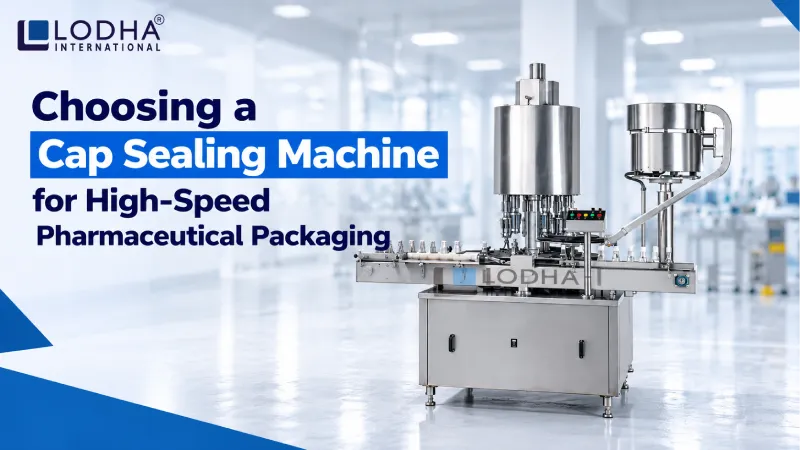
For instance, Lodha’s high-speed rotary bottle capping machine is engineered to handle round caps and can achieve a production capacity of up to 200 bottles per minute, with its operating speed influenced by bottle dimensions, shape, and cap size. It supports plastic screw or CRC caps up to 32 mm in the published configuration.
Higher machine speed is useful only when the entire packaging line can handle the same production flow.
Selecting an oversized capping machine for a slower filling or Labeling line may not provide a practical production advantage.
Check Bottle and Cap Dimensions Carefully
Before choosing a Cap Sealing Machine Manufacturer in India, B2B buyers should confirm the actual bottle and closure details.
A machine must be selected according to the physical format of the package, not only according to the number of bottles required per minute.
- Bottle diameter and height
- Bottle or vial shape
- Cap diameter and cap type
- Neck finish or closure specification
- Required production speed
- Existing filling and Labeling equipment
- Available changeover requirements
Providing these details helps our team determine whether a single-head, multi-head, linear or rotary configuration is more appropriate.
Single-Head or Multi-Head Capping?
Single-head capping machines can be suitable for moderate production requirements and applications where flexibility is more important than maximum throughput.
For example, the LI-BCS 1 single-head screw capping machine is specified for bottles up to 85 mm in diameter, suitable bottle heights up to 150 mm and plastic screw or CRC caps up to 38 mm, with production speeds up to 60 bottles per minute depending on the application.
When higher output is required, four-head, six-head, eight-head or high-speed configurations can be evaluated according to the bottle and closure format.
Consider Line Integration, Not Just Capping
In a pharmaceutical packaging line, capping normally operates between filling and downstream operations such as inspection or Labeling.
Bottle movement therefore needs to coordinate with the preceding and following machines. Conveyor height, bottle transfer, infeed arrangement and outfeed handling should all be considered when the system is specified.
As a Cap Sealing Machine Manufacturer in India, we recommend discussing the entire packaging sequence during machine selection rather than treating the capping section as an isolated unit.
Machine Features to Review for Pharmaceutical Production
For pharmaceutical applications, machine construction and operational control are important selection points.
Depending on the selected model and configuration, relevant features can include:
- Stainless-steel construction and cleanable surfaces
- Automatic bottle infeed and discharge
- Cap feeding and placement systems.
- Variable-speed operation
- Bottle and cap sensing.
- Safety guarding and interlocks
- Integration with filling, inspection and Labeling equipment
Suitable pharmaceutical configurations can be designed to support EU GMP and US FDA cGMP requirements, with the supplied construction, controls and documentation defined according to the approved machine scope.
Advanced features, including SCADA integration and compliance with 21 CFR Part 11, should be included in the specifications only after verifying their availability and compatibility with the chosen machine configuration.
How to Select the Right Output Level
The required production speed should be determined based on the overall production demands of the entire line. A buyer should consider the output of the filling machine, expected bottle format, capping mechanism and the capacity of downstream Labeling or packing equipment.
For a manufacturer running several bottle sizes, changeover requirements may also be as important as maximum output. Working with a Cap Sealing Machine Manufacturer in India allows these variables to be reviewed together before the final capping configuration is selected.
Why Choose Us
At Lodha International LLP, we manufacture a broad range of pharmaceutical capping solutions including screw capping, ROPP capping, vial cap sealing, linear capping and high-speed rotary systems. We focus on selecting equipment according to the actual bottle, closure and production requirement. As a Cap Sealing Machine Manufacturer in India, our team can also consider how the capping machine will integrate with filling, Labeling and other packaging equipment within the complete production line.
Conclusion
Choosing a cap sealing machine for high-speed pharmaceutical packaging requires a clear understanding of the container, closure type, required output and overall line configuration. A single-head machine may suit one production setup, while multi-head, linear or rotary high-speed equipment may be more appropriate for another.
Lodha International LLP provides different capping configurations for bottles and vials so manufacturers can select the system according to their actual production process. The right machine should balance output, closure compatibility, bottle handling and integration rather than focusing on speed alone.
Planning a new pharmaceutical capping line or upgrading an existing one? Contact Lodha International LLP with your bottle size, cap type and required production output, and our team can help you identify a suitable configuration.
Phone: +91-7435031331
Email: info@lodhapharma.com
FAQs
Cap Sealing Machine Pharmaceutical Capping Machine Bottle Capping Machine Vial Capping Machine ROPP Capping Machine Screw Capping Machine High Speed Capping Machine Pharmaceutical Packaging Bottle Sealing Machine Packaging Machinery